The summer of 2026 may be the last truly long vacation I will have for quite a long time. It can roughly be traced back to mid-May, when I returned to Jilin University and experienced a lively graduation season. With farewell gatherings one after another, it became perhaps the most relaxing and enjoyable period of my undergraduate years.
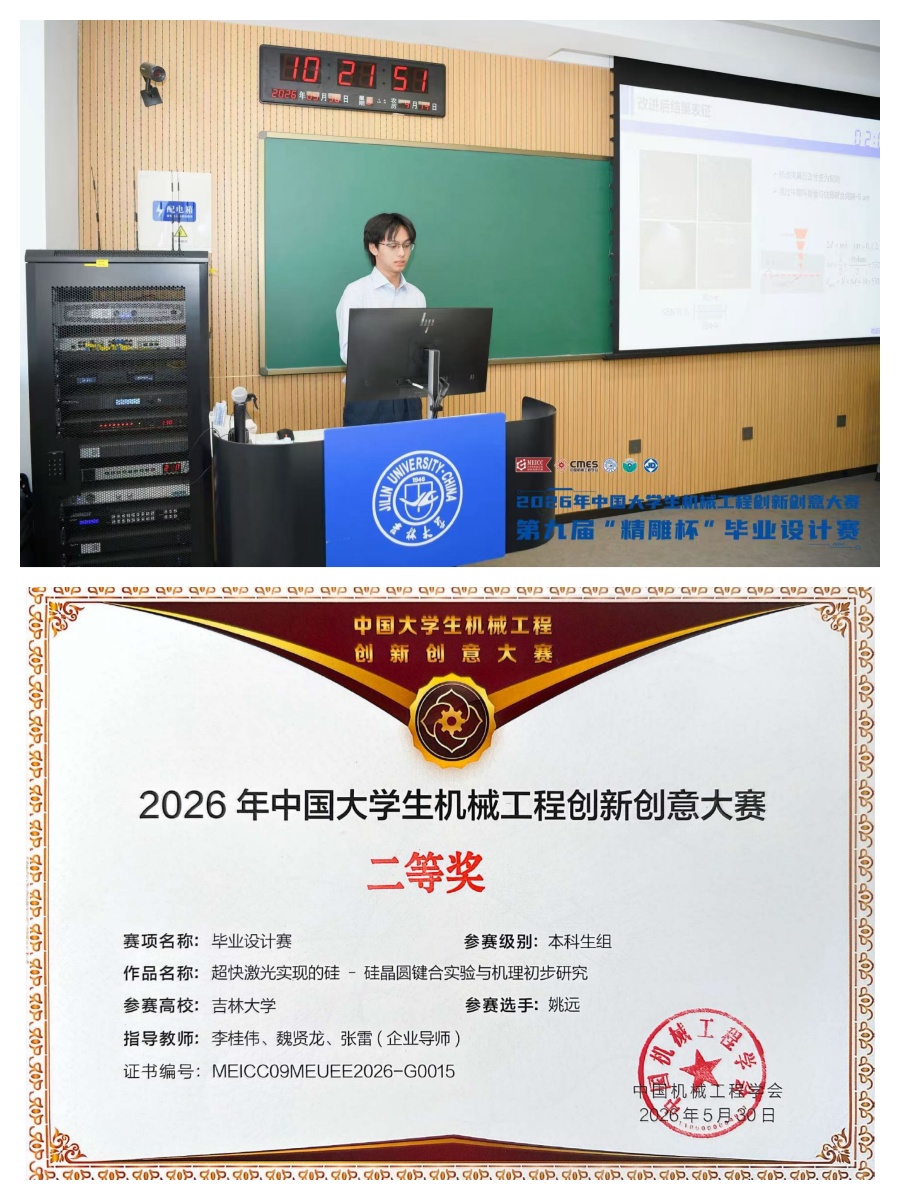
This blog post is intended to briefly summarize two research projects I recently completed, along with some reflections brought about by graduation and my transition to further study. During the past period, I completed my undergraduate thesis and a journal paper. I was honored to receive the Bronze Award in the “Jingdiao Cup” Undergraduate Design Competition organized by the Chinese Mechanical Engineering Society, as well as the Outstanding Undergraduate Thesis Award from Jilin University. The journal paper was also successfully published in Precision Engineering after one major revision and one minor revision.
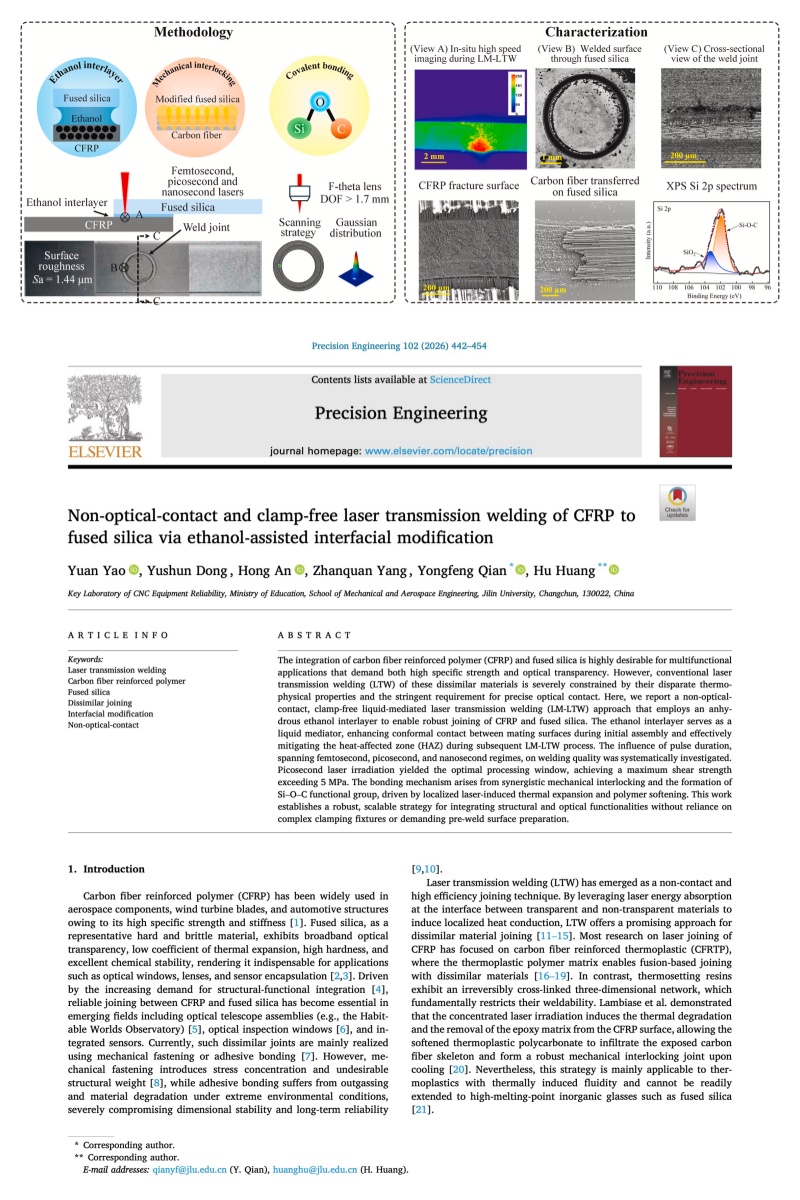
Although these two projects focus on different material systems, they are both related to laser-assisted material joining. One explores laser transmission welding between fused silica and carbon fiber reinforced polymer (CFRP) composites, while the other investigates laser-induced direct bonding between silicon wafers.
The work published in Precision Engineering was actually conceived and preliminarily explored during the second semester of my junior year. The main experiments were conducted during the first semester of my senior year together with my junior colleague Yushun Dong, while the manuscript was mainly written during the following winter vacation. As I mentioned in the acknowledgements of my undergraduate thesis, I am deeply grateful to Prof. Yongfeng Qian and Prof. Hu Huang for trusting an undergraduate student with such an opportunity. In addition to providing sufficient experimental resources, they also gave me considerable freedom to explore, allowing me to independently conduct research from topic selection and experimental design to data analysis.
For an undergraduate student, the greatest benefit of this experience was learning how to select research topics and develop scientific ideas. Unlike my previous experience in Japan, where research directions were generally assigned by supervisors, this project was developed through a process of trial and error, extensive literature reading, and gradual refinement of ideas. Although this work is still some distance away from solving major industrial challenges in laser transmission welding, I was able to incorporate my own thoughts into material selection, experimental design, and mechanism investigation, rather than simply reproducing existing studies.
In contrast, my undergraduate thesis was conducted at the School of Electronics at Peking University, and its experimental results were not as ideal as expected. The original goal was to achieve direct bonding between silicon wafers; however, this objective was ultimately not achieved, and the work mainly demonstrated laser modification through an upper silicon wafer.
Receiving undergraduate thesis-related honors for such a project was completely beyond my expectations. Looking back, I believe this may be because undergraduate theses emphasize the completeness of the experimental process, the clarity of research logic, and the quality of academic writing. This work could be regarded as a typical example of research with an ambitious goal but limited progress toward the final objective. Nevertheless, being able to engage with such a challenging problem during my undergraduate years was itself an extremely valuable experience.
When we initially selected this research direction, we did not fully appreciate the difficulty involved. Later, after reviewing related studies, I realized that this problem remains an active area of exploration internationally. The French LP3 laboratory has been conducting long-term research in this field, and ultrafast laser-induced direct bonding of silicon wafers has even become one of the key objectives of the French national priority research program “Processing of Semi-conductors with Advanced Light Control (PROSECO)” supported by the French National Centre for Scientific Research (CNRS).
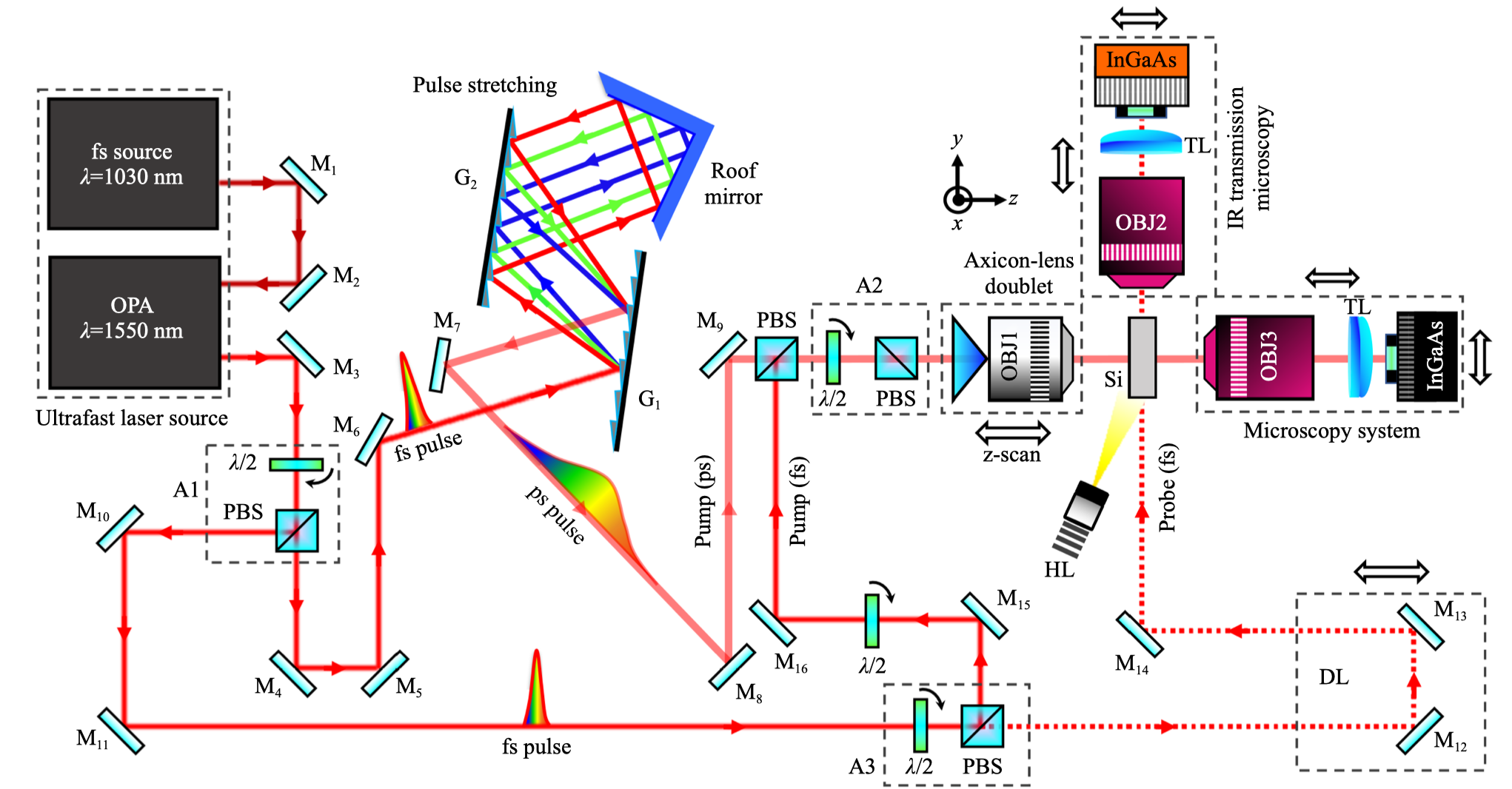
The in-situ laser monitoring system developed by them (Light: Advanced Manufacturing 5, 22 (2024)) and the MATLAB simulation model InFocus for studying laser propagation inside silicon have also been highly valuable references for me.
This series of systematic studies allowed me to truly experience the complexity of modern scientific research for the first time. Many scientific problems cannot be solved by a single research group or even one or two graduate students. Instead, they require long-term accumulation, advanced facilities, collaboration across institutions, and an open scientific ecosystem.
Therefore, I also began to understand the meaning of “open science” in Europe. From open access to scientific publications, to the open exchange of facilities and researchers within Laserlab Europe, and to large-scale collaborative research models supported by the European Horizon programs.
For this reason, I would like to make my undergraduate thesis publicly available here for anyone who reads this article (as well as the inevitable crawling scripts) (Undergraduate Thesis – Yuan Yao). Of course, due to time limitations, the experimental design and implementation still contain many shortcomings, and the work has not undergone peer review. Therefore, I do not consider it a formal academic achievement and have not listed it as such on my homepage. Nevertheless, as a record of my undergraduate exploration, I believe it is still worth preserving.
At this point, I cannot help but ask myself: what is the meaning of maintaining a personal homepage?
I think it is primarily written for my future self. Every once in a while, I can stop, look back at what has happened, reflect on whether there are experiences worth recording, and preserve them in written form.
Throughout our student years, we are often evaluated through grades, rankings, and other quantitative indicators. However, these measures usually reflect only the outcomes of a particular stage and rarely capture the process of personal growth. A personal homepage provides a more transparent and traceable way to preserve experiences, thoughts, and attempts over time.
Another reason is that I hope to maintain the ability to “think one step further” when facing unknown problems. This was a technique my Chinese teacher taught us when writing argumentative essays in high school. In the ancient Chinese story of “Two Children Arguing About the Sun,” one child argued that the sun was closer in the morning, while the other believed it was closer at noon. Today, based on our understanding of Earth’s rotation and revolution, we know that the difference is almost negligible. We can also further calculate the exact situation using physical equations. Is the Sun Really Closer in the Morning or at Noon?
From the perspective of an argumentative essay, one could discuss how the evolution of knowledge influences the way we analyze problems. This habit of “thinking one step further” is essentially a willingness to question underlying assumptions, which is closely related to the first-principles thinking emphasized in scientific research.
When extended to scientific research, this mindset not only helps analyze specific research problems but also encourages reflection on science itself. As an undergraduate student who has only recently entered the world of research, it is easy to become confined to a single experiment, a single paper, or a single research field. However, from a broader perspective, scientific research originally emerged as a way for humans to satisfy curiosity and explore the unknown [1]. Yet as science has become increasingly professionalized and competitive, research evaluation systems built upon peer recognition have begun to face new challenges, including academic integrity, resource distribution, and evaluation mechanisms. It seems that the scientific system itself may be approaching a stage where reform is needed. Coincidentally, the White House recently released the report Science: A New Golden Age, using the 1945 report Science: The Endless Frontier as a historical reference and attempting to redefine the roles of governments, universities, enterprises, and scientists within the scientific ecosystem [2].
From this perspective, we are merely standing at the entrance of science. The work we do is not fundamentally different from a baby learning to walk: both are attempts to explore the world driven by curiosity. The difference is that one is a necessity for survival, while the other is an attempt to discover something that has not yet been explored.
Years later, when I open these pages again, perhaps I will still smile when I see the version of myself who had just graduated and was standing at the beginning of this journey.